Blog

How often should I water my oak trees?

Oak trees rarely need extra watering because they thrive with natural winter rainfall and naturally dry weather the rest of the year. In fact, watering oak trees by means other than rainfall can kill them and make them vulnerable to disease. The recommendation is to plant oak trees in California in the late fall, before the winter rain. The tree service specialists from Paso Robles’ Golden State Tree Solutions report that some supplemental monthly monitored watering may be necessary in the first and second summers.

Supplemental watering should be slow, deep, and away from the trunk, as close to each tree’s drip line as possible. The drip line is the ground under the outermost edge of the branches where rainwater drips onto the soil. When planting young oaks where there are no other oak trees,  a few inches of mulch applied within the drip line, but not touching the trunk, helps the soil retain moisture.

Oak trees are susceptible to diseases such as oak wilt, canker, root rot, blight, blister, and powdery mildew. The healthier the tree, the more resistant it is to disease. However, oak trees, like any other plant native to California is not as resistant to invasive diseases and insects. Invasive diseases and insects are those that have arrived from other non-California environments, including other states and countries.

Oak trees are also vulnerable to the invasive oak borer beetles. The goldspotted oak borer, brought to California from Arizona and Northern Mexico in the late 1990s, has spread throughout California and is a major threat to mature oak trees. The Mediterranean oak borer is another invasive that has become a threat to oak trees in Northern California.

Long-term drought followed by extremely wet winters can also damage oak trees by causing them to drop limbs. Although limb dropping due to the drought/rain cycle is part of the natural cycle, professional, knowledgeable pruning is the best way to prevent serious damage to oak trees that are dropping limbs.

How can I tell if my oak trees are diseased?

Inspect for yellowing leaves, abnormal or unseasonal leaf loss, changes to the canopy and branches, and dark, oozing cankers on the trunk. Weakened and cracking branches are also signs of disease, drought stress, or normal aging.

“Dropping branches is a natural shedding process, and not necessarily an indication of disease. But, managing broken branches with appropriate pruning can help prevent property damage from falling branches and protect the tree from scarring that may leave it vulnerable to regional diseases and infestations,” reports the Paso Robles tree service specialists.

Keep your oak trees healthy, and help them recover from damage with:

  • Pruning and maintenance.
  • Protecting the root zone.

Pruning and maintenance

For oak trees, pruning is the process of removing aging, brittle, diseased, and dead branches. Pruning helps the tree preserve energy for healthy growth, rather than using it to fight disease.

Pruning after branches drop also helps the tree stay healthy. Cleaning up the scar from a branch breaking helps prevent insect invasion and supports the tree’s natural resistance to disease.

Don’t seal pruning cuts.

The best times to prune are:

  • Late winter/early spring, while the oaks are still dormant.
  • Anytime dead branches or disease are observed.
  • As soon as possible after a branch has broken off.
  • Immediately, when a branch is cracking, damaged, or preparing to drop.

Seasonal inspection helps keep trees healthy. One inspection during dormancy reveals potential problems that may not be visible once the tree has leafed out. A spring inspection, when new growth is sprouting, is generally a good time to spot areas that need attention.

Protecting the root zone

Protect the root zone by keeping it free of any activity that can damage roots. The root zone is an area about four times the size of the tree canopy, meaning it extends a considerable distance past the drip line. Aside from the taproot, most of a tree’s root system is in the top 18 to 30 inches of soil.

Avoid digging, trenching, or paving within the root zone, and minimize parking.

Landscape under oaks by mimicking natural growth, using drought-tolerant native plants such as hummingbird sage, Dutchman’s pipe, and some varieties of ceanothus. Plant at least 6 to 10 feet away from the trunk. Several native California plants thrive along with oak trees.

Where to learn more

The California Native Plant Society is a top source for information about oak trees. Local universities and colleges, especially those with plant science programs, are excellent sources of information. Local nurseries that specialize in native California plants are another important source. Local farm bureaus are good sources for information about diseases and harmful insects.

Getting professional solutions

Learning about oak trees gives you the knowledge to help identify when your trees may be in distress. Professional support from Paso Robles’ Golden State Tree Solutions helps you take the necessary steps.

The company has served California’s Central Coast since 2007, and owner Jesus Morales brings over 30 years of experience in tree solutions. Golden State Tree Solutions is the local, family-owned, dependable tree service for Paso Robles and nearby inland and coastal communities, San Luis Obispo County, King City, and Santa Maria.

  • Do you need a diseased or dying tree removed?
  • Is it time to shape the trees and shrubs in your landscaping?
  • Are you clearing your property for defensible space?
  • Is a tree overgrowing and threatening your roof?
  • Do your trees have dead branches?

The Golden State Tree Solutions team takes pride in doing the job right, on time, with minimal intrusion on your time and your property.

“Our services focus on the long-term health of trees, shrubs, and your land, helping keep your property attractive, safe, and clear of fire fuel,” says the owner, Jesus Morales.

Call for an appointment!

Read Now

The best time to prune trees—a quick-reference guide from the Paso Robles tree service

California’s prolonged winter chill and extra rain in early 2026 have made it challenging for many to keep up with tree pruning, gardening, and weed abatement. Fortunately, the state’s temperate microclimates allow for late gardening once the weeds are under control, but what about pruning trees? Is late summer too early? Jesus Morales, owner of Golden State Tree Solutions, reports that timely pruning depends on the kind of tree.

Circumstances that may require immediate pruning include emergencies, disease, and damage. Emergencies encompass a tree that can damage property or overhead wires by falling or dropping branches. Pruning diseased or damaged trees as soon as possible helps keep them healthy.

Pruning quick reference guide

Here is a guide for scheduling normal pruning for the type of tree in California:

  • Deciduous and fruit trees—late January through early March.
  • Oak trees—July through October.
  • Flowering trees—when they have finished blooming.
  • Evergreens and summer-blooming shrubs—late winter.
  • Ornamental, shaped trees and shrubs—when the only purpose is ornamental landscaping, trees and shrubs can be trimmed to maintain shape, with care, regularly. To preserve flowers, only shape them when the blooming is finished.

This quick reference guide helps you identify the ideal pruning times. Golden State Tree Solutions is available to help by answering questions and providing no-fee estimates. The company has been in business since 2007, providing tree services to Paso Robles, San Miguel, Atascadero, San Luis Obispo, Arroyo Grande, and communities throughout the county.

Deciduous and fruit trees

It’s easy to see the branching structure when trees have dropped their leaves and are dormant. Pruning while a tree is dormant prevents sap loss and maximizes spring growth. It also promotes higher crop yields.

Pruning dead, weak, or diseased branches anytime is a good management practice because it helps prevent pests and the spread of disease.

Oak trees

Oaks rarely need pruning unless disease or pests are present, or branches are dying or damaged. Native California oaks are dormant in the summer, and this is a safe time to examine the tree for branches that need to be pruned.

Pruning in winter or spring, during wet, cool conditions, can lead to fungal infections and the spread of Sudden Oak Death.

Pruning off damaged and dying branches, or trimming up a scar from a broken branch, can be considered an emergency and done anytime. Working with a professional service makes sure the pruning is done correctly to reduce the chances of disease or pest infestations.

Flowering trees and shrubs

Flowering trees that don’t produce edible fruit are glorious when at their peak. Wait until the blooming season is over to prune, usually late spring or early summer, depending on the tree. Pruning too early destroys the flower buds. Pruning too late can also affect the next season’s flower buds.

Evergreens and summer-blooming shrubs

Late winter pruning encourages new spring growth. The plant is dormant, so pruning doesn’t force new growth too early. Insects and fungal spores are less active in cold temperatures, reducing the risk of spreading infections. Pruning can also improve airflow and let more light into canopies, prevent mold, and encourage new growth.

Ornamental, shaped trees and shrubs

When trees and shrubs are chosen to add manicured shapes to landscaping, they can usually be shaped year-round. Shaping isn’t necessarily the same as pruning because only surface growth is trimmed.

However, it’s important to examine the plant at each shaping. Branches and twigs support the leaves, and at some point, shaping removes all of the growth from a branch, leaving it bare and disrupting the desired groomed shape. At that point, some deeper pruning is needed to help retain the desired shape and healthy appearance.

Emergency tree services

The Paso Robles tree service provides 24/7 emergency tree services. When a tree has fallen or dropped a branch that damages property, is blocking vehicle and foot traffic, or is diseased or damaged, the sooner help arrives, the sooner the problem is fixed.

Golden State Tree Solutions is a full-service, licensed, and insured company providing a full range of tree and landscaping services, including:

  • Dead fallen tree removal.
  • Live and diseased tree removal.
  • Mistletoe removal.
  • Stump grinding.
  • Pruning, trimming, and shaping.
  • Weed abatement.
  • Defensible spaces.
  • Assistance with the tree removal permit process in most cases.
  • Need wood chips? Ask them!
  • And more.

The team brings more than 30 years of combined experience to tree, shrub, weed abatement, and defensible space solutions. Reach out today!

Read Now

Old Oak Tree Trimming in Paso Robles

Restoring a Historic Oak Tree with Professional Care

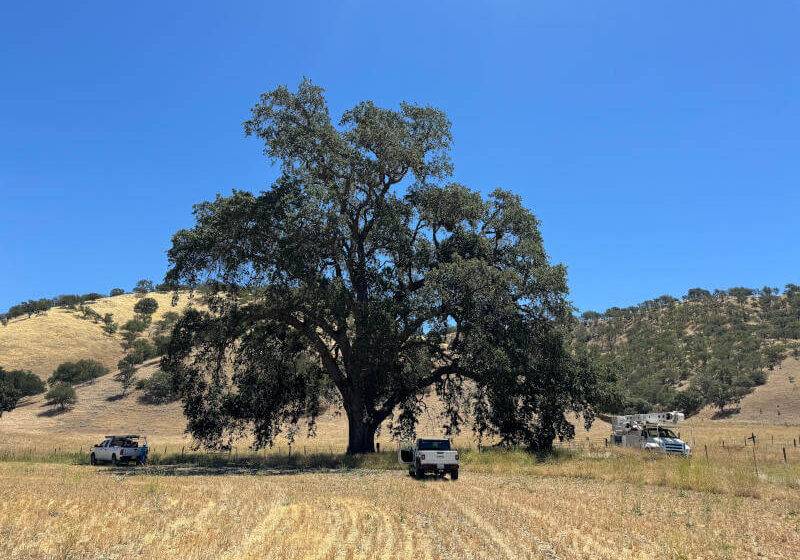
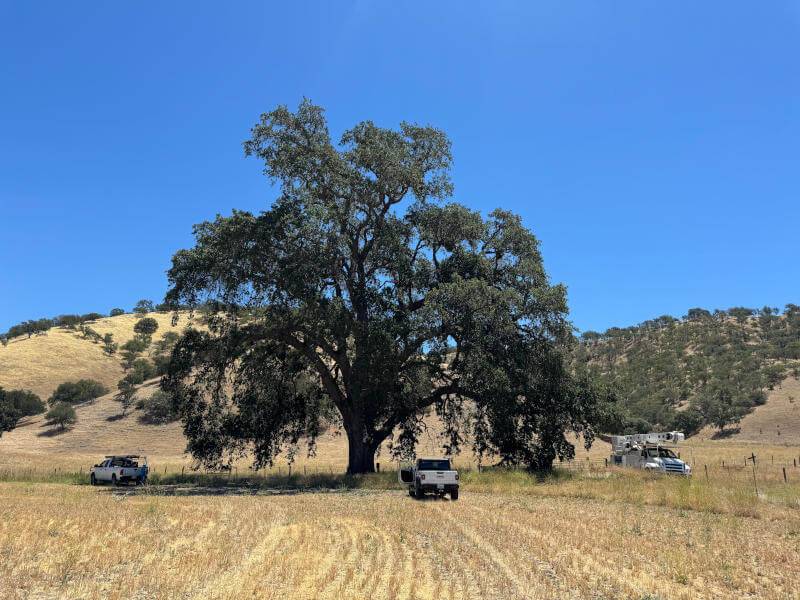
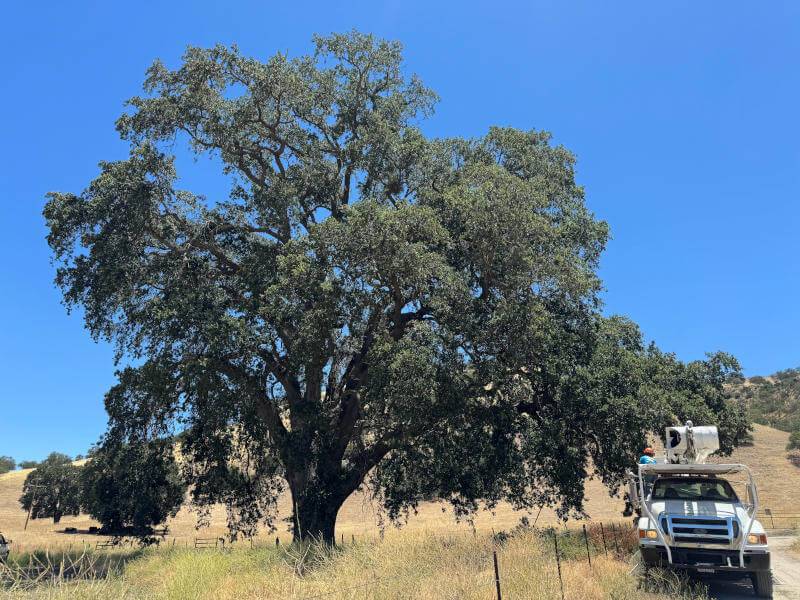
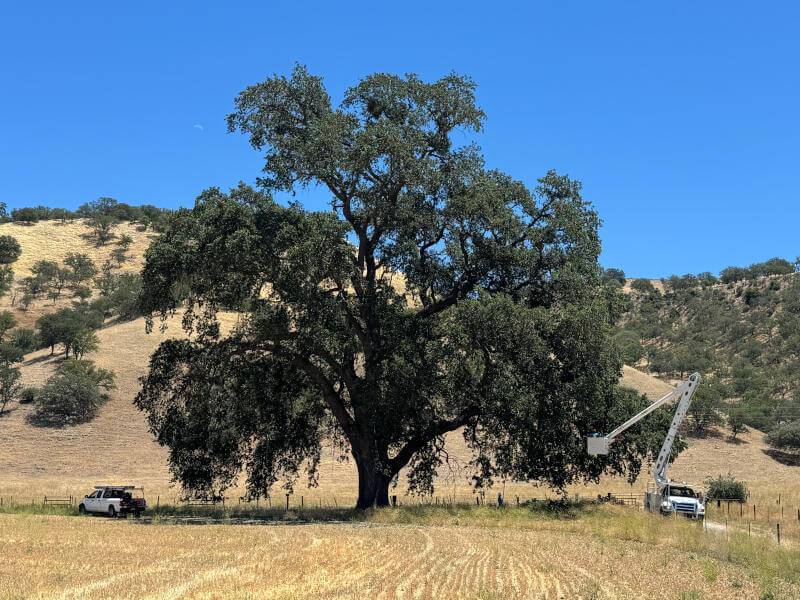
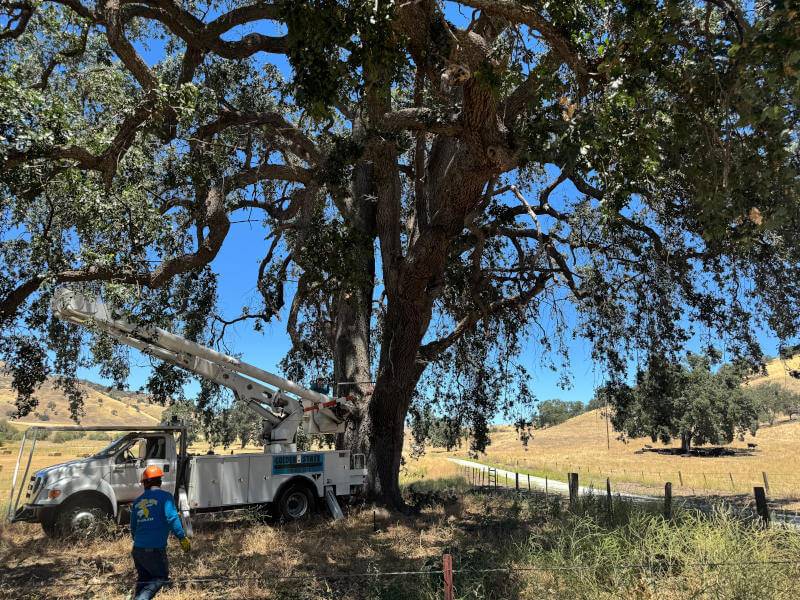
When it comes to Old Oak Tree Trimming in Paso Robles, few projects are as rewarding as preserving the health and beauty of a mature oak tree. Recently, the team at Golden State Tree Service completed a detailed tree trimming project on an impressive heritage oak tree right here in Paso Robles, helping extend its life while improving its appearance and overall health.

If you have a legacy oak on your Central Coast property, here’s what that process can look like, and why it matters.

How often should an old oak tree be trimmed?

Most mature oak trees in Paso Robles benefit from professional trimming every 3 to 5 years, depending on growth rate, health, and proximity to structures.

Caring for a Beautiful Historic Oak Tree in Paso Robles

This remarkable oak tree featured a massive trunk measuring approximately 25 feet in diameter, making it one of the most impressive specimens in the area. Over many years, the tree had accumulated dead branches, excessive sucker growth, and mistletoe infestations that were beginning to impact its health and appearance.

Our experienced crew carefully evaluated the tree and developed a trimming plan focused on preserving its natural structure while removing problem areas. Trees of this size and age are common throughout Paso Robles, Templeton, and the surrounding wine country, and they require a trained eye to trim correctly.

Old Oak Tree Trimming Services Performed in Paso Robles

For this Paso Robles tree trimming project, our team completed:

  • Removal of dead and hazardous branches
  • Elimination of sucker growth around the trunk and major limbs
  • Professional mistletoe removal
  • Selective canopy cleaning to improve tree health
  • Cleanup and debris removal

By removing dead wood and parasitic growth, we helped reduce potential hazards while allowing the tree to direct more energy toward healthy growth.

Protecting the Health of Mature Oak Trees on the Central Coast

Large oak trees are an important part of the Paso Robles landscape. Proper trimming requires experience, specialized equipment, and an understanding of how mature trees respond to pruning.

Improper trimming can weaken an oak tree, increase disease risks, or create long-term structural problems. Our crew uses industry-proven techniques to protect tree health while enhancing safety and appearance.

For this project, special care was taken to preserve the tree’s natural shape and character while removing only the material that was affecting its health.

Why Mistletoe Removal Matters for Paso Robles Oak Trees

Mistletoe is a common issue for oak trees throughout Paso Robles and San Luis Obispo County. While it may appear harmless, mistletoe is a parasitic plant that draws nutrients and water from the host tree.

Professional mistletoe removal helps:

  • Improve tree health
  • Reduce stress on branches
  • Prevent further spread
  • Preserve the tree’s natural beauty

Removing mistletoe as part of routine tree maintenance can significantly extend the lifespan of mature trees.

A Heritage Oak Tree Worth Preserving

As owner Jesus Morales noted, this was truly a “beauty tree.”

The transformation was remarkable. After the dead branches, suckers, and mistletoe were removed, the oak’s impressive structure and natural beauty became even more visible. Projects like this showcase the pride our crew takes in helping preserve some of the Central Coast’s most valuable trees.

Professional Old Oak Tree Trimming in Paso Robles

Golden State Tree Service has been providing professional tree care throughout Paso Robles and San Luis Obispo County since 2007. As a family-owned, fully licensed and insured company with over 30 years of combined industry experience, we specialize in:

  • Tree trimming and pruning
  • Oak tree maintenance
  • Mistletoe removal
  • Tree removal
  • Stump grinding
  • Defensible space clearing
  • Brush clearing and weed control
  • 24/7 emergency tree service

Whether you have a mature oak tree that needs professional attention or you’re looking to improve the health and appearance of your landscape, our team is ready to help.

Read Now

When is the best time to prune, fertilize, and care for my trees?

A tree care guide from Golden State Tree Solutions

Healthy trees are important for a healthy environment. Not only are they beautiful to see, trees provide food and shelter for wildlife, and shade for all on hot days. Healthy fruit and nut trees feed families. Keeping trees healthy helps prevent diseases that lead to broken limbs, dead trees, and property damage from fallen trees and branches.

Trees growing in orchards, backyards, livestock pastures, and public streets and parks often need more attention than those growing in natural habitats. The Golden State Tree Solutions team has a tree care guide to help you keep your trees healthy throughout the year.

Locally owned and operated, Golden State Tree Service serves Atascadero tree service needs, all of San Luis Obispo County, as far north as King City and south as Santa Maria.

Tree and shrub care for every season

Some species of trees and shrubs may need additional care throughout the year, especially fruit and nut trees, and ornamentals that are not native to where they are growing. Saplings, aging, and damaged trees also need additional monitoring and care. The Atascadero tree service is ready to respond to emergencies and to assist with caring for trees and shrubs anywhere on the Central Coast.

In general, the following months are classified into the seasons; however, there are often “transition” months between the seasons.

  • Winter months are December to February.
  • Spring is March through May. May is also a transition month between spring and summer, when some trees and shrubs need additional attention.
  • Summer runs from June through August, and August is a transition month between summer and fall. Some trees and shrubs start to prepare for fall, while some are just entering their most fruitful stages.
  • Fall is from August through November, although some fruit and nut trees continue to produce fruit into December. 

Winter tree care

Trees are dormant in the winter, but they are not totally at rest. It’s the time when trees are conserving energy, protecting themselves from cold and winter storms, and preparing for spring growth. What seems to be a tree at rest from the outside, internally it’s growing roots, absorbing nutrients, and forming leaf and flower buds to be ready for spring.

Care tips for winter include:

  • Pruning for structure. While fall is the ideal time for pruning, winter is also acceptable, provided you have already identified the branches that need to be removed. If you miss fall pruning, it’s generally okay to prune in early spring, especially fruit and nut trees.
  • Removing dead and damaged branches helps the tree preserve energy and reduces the risk of further damage or disease.
  • Inspect for pests, cracks, and other damage. Keep an eye on rainwater flooding around the base, and in some areas, snow or ice damage.
  • Mulch, depending on the species. Most California natives don’t survive mulching, and some trees or shrubs do best when mulch is at least 12 inches away from the trunk.
  • Fertilizing in late winter also depends on the species.

Spring tree care

Spring is a time of rapid growth as trees and shrubs sprout new leaves, and the buds and flowers that become fruit. Some species also send up sprouts in the spring, and grasses and other weeds grow as well. Spring is also the time when undetected winter damage becomes apparent, and time to start monitoring watering.

  • Inspect for new growth, pests, winter damage, and remove dead or diseased branches.
  • Additional pruning for fruit and nut trees to promote more fruit production.
  • Pull weeds from under and around trees and shrubs. If you use herbicides, stay outside of the drip line, use a shield, and don’t spray on windy or breezy days.
  • Fertilize according to the plant’s needs.
  • Replenish mulch.
  • Remove any winter protective wraps or covers.
  • Avoid installing bird nets in the spring. Nets also keep out needed pollinators.

Summer tree care

Spring flowers become fruit during the summer and fall. Some trees and shrubs need additional watering during the dry summer months.

  • Monitoring tree health and watering are the primary care tasks during summer.
  • Inspect for pest infestations, especially in fruit and nut trees.
  • Watch for bird damage to fruit. If bird deterrents are not working, summer is an appropriate time to install bird nets. Keep in mind that birds can be trapped inside the nets, so regular inspections are necessary.
  • Where there’s water, there are weeds. Hand-pull the weeds to prevent competition for nutrients.
  • Monitor for signs of drought stress.
  • Stone fruits start ripening in summer. Start harvesting as the fruit is ready, and clean up any dropped fruit daily.

Fall tree care

Many trees and shrubs start going dormant in the fall, and some fruit and nut trees are ready to harvest.

  • Harvest fruit as it is ready, and clean up dropped fruit daily.
  • Water as needed. Pull weeds as needed.
  • As trees begin dropping leaves, rake them away from the trunk and reuse as mulch.
  • Continue to inspect for damage, pests, and disease.
  • Young trees may need winterizing. Older trees may also benefit from extra winterizing.
  • Fall is a good time for pruning and for removing damaged branches.

Always ready to help

Golden State Tree Solutions, your tree service for Atascadero, all of San Luis Obispo County, and King City, is always ready to help keep your trees healthy. Founded in 2007, our services include:

  • Weed abatement to remove dry weeds that are fire hazards.
  • Defensible space around homes, businesses, and other buildings is a fire prevention strategy that is now California law.
  • Dead or fallen tree removal.
  • Live tree removal for diseased or hazardous trees.
  • Shrubbery pruning and removal.
  • Pruning and shaping trees and shrubs to remove dead branches and restore the natural shape.
  • Stump grinding.
  • Mistletoe removal.

At Golden State Tree Solutions, we take care of Arroyo Grande, Los Osos, Grover Beach, Avila Beach, and coastal communities. We serve all of San Luis Obispo County, communities near King City in Monterey County, and near Santa Maria in Santa Barbara County.

We provide free estimates and are available 24/7 for emergencies.

Read Now

When There’s No Room to Work: Paso Robles Tree Removal Services for Challenging Locations

Some trees grow in perfect spots. Open yards, wide clearances, easy access. Others seem to pick the most inconvenient location possible — wedged between two homes, leaning over a roofline, or pressing against a foundation with nowhere to go. That’s where things get complicated. Golden State Tree Service handles exactly these situations, delivering professional Paso Robles tree removal services to homeowners dealing with trees that have outgrown their space in all the wrong ways.

When Space Disappears, Risk Increases

A tree growing in a confined space isn’t just an inconvenience. It’s a liability. Every inch of clearance that disappears between a tree and a nearby structure raises the stakes on removal. A miscalculated cut doesn’t just mean a messy yard. It can mean a cracked wall, a shattered window, or damage to a neighbor’s property.

Tight spaces demand a different mindset. Standard removal techniques don’t apply. The crew needs to slow down, assess carefully, and plan every cut before a chainsaw ever starts. Experience isn’t optional in these situations. It’s the whole job.

Paso Robles tree removal between two homes

What Makes Confined Tree Removal Different

Open-yard removals follow a predictable rhythm. Equipment gets positioned. Cuts get made. Sections fall to the ground with room to spare. None of that works when a tree is growing two feet from a house.

Confined removals require working from the top down. The tree comes out in sections, not all at once. Each piece gets rigged with ropes and lowered to the ground in a controlled manner. It takes longer. It requires more coordination. But it’s the only method that protects the structures around the tree and the people doing the work.

Here is what a professional tight-space removal looks like from start to finish:

  • Site assessment to identify obstacles, utility lines, access points, and risks before any equipment arrives
  • Top-down sectional cutting that removes the tree piece by piece rather than in one uncontrolled drop
  • Rope rigging and controlled lowering of each section to keep surrounding structures safe
  • Ground crew coordination to manage debris, reposition rigging, and maintain a clear work zone throughout the job
  • Stump grinding once the tree is fully removed, even in areas with limited equipment access
  • Full property cleanup before the crew leaves, including wood, chips, and any remaining debris

Cutting corners on any one of these steps introduces risk into an already demanding job.

Choosing the Right Tree Removal Service Near Me

Not every tree company is equipped for this kind of work. When someone searches for a tree removal service near me, the results include everyone from highly experienced crews to operations that handle simple jobs and little else. The difference matters enormously when the location is difficult.

A qualified Paso Robles tree service brings more than just equipment. They bring familiarity with local tree species, residential lot configurations, and the specific challenges found in neighborhoods where homes sit close together and trees have been growing for decades. That local knowledge shapes every decision made on a tight-access job.

Ask the right questions before hiring anyone. Do they have direct experience with confined-space removals? Are they licensed and fully insured? Does the estimate reflect the actual complexity of the job, or just the parts that are easy to account for?

How Much Does Tree Removal Cost for a Difficult Job?

How much does tree removal cost when the location complicates everything? The answer depends on several variables. Tree size matters. So does proximity to structures, the amount of rigging involved, access limitations, and the total crew hours required.

A tree that needs to be hand-carried through a narrow side yard piece by piece costs more to remove than one with open access. That’s simply the reality of confined-space work. The labor is more intensive. The risk management is more demanding. The time on-site is longer.

What isn’t worth doing is choosing the lowest bid without verifying that the crew can actually handle the job. A damaged fence is an inconvenience. A cracked wall is expensive. Damage to a neighbor’s property is worse. The price difference between a careful, experienced contractor and an unprepared one is almost always smaller than the cost of fixing what goes wrong.

The Right Crew Changes the Outcome

Difficult removals don’t leave room for learning on the job. The tree is either removed safely or it isn’t. Structures nearby are either protected or they aren’t. There’s no middle ground when clearances are tight and stakes are real.

Golden State Tree Service has been providing trusted Paso Robles tree removal services across the Central Coast for over 30 years. Tight spaces. Challenging angles. Locations that make other crews hesitate. That’s exactly the kind of work they’re built for.

Read Now

Golden State Tree Service showcases services in a new website

-Golden State Tree Service recently announced it has launched a new website, designed by Access Publishing. Owner Jesus Morales said, “We are excited about this opportunity to provide our customers with pictures and videos of our work.”

The new website showcases the team’s work with photographs and videos that demonstrate the quality of work. Working with trees that have overgrown roofs, are too close to a structure, requires precision that is best demonstrated, rather than explained. “When our customers see photos of projects similar to theirs, or can watch a video of our equipment in action, they understand the process,” said Morales.

The website also answers the most common questions people have about tree care. Those questions include questions about permit processes, mistletoe, the health benefits of pruning and trimming a tree, and much more.

The company has been serving Paso Robles, Atascadero, and nearby inland and coastal communities, San Luis Obispo County, King City, and Santa Maria since 2007. Morales also brought several years of experience in the horticulture industry to Golden State Tree Service.

“We work with property owners and caretakers who understand the importance of healthy trees, and the careful processes that are needed to remove and protect trees,” said Morales.

Golden State Tree Service is local, family-owned, licensed, and insured. The Paso Robles tree service team’s focus is on helping property owners, property managers, HOAs, and public spaces keep trees, shrubs, and defensible spaces within regulatory requirements.

“We help manage trees and shrubs for the right balance of shade and sunlight, and seasonal pruning,” reports Morales. Services focus on the long-term health of trees, shrubs, and land, helping keep properties attractive, safe, and clear of fire fuel.

Tree services are about working with property owners to keep trees and shrubbery healthy. Pruning and trimming are important for healthy trees. Removing diseased branches, or entire trees or shrubs, helps keep surrounding trees and shrubs healthy.

The team is familiar with the unique needs of properties on the Central Coast. Equipped with advanced tools and equipment, every project is undertaken with a positive solutions approach. Services include:

  • 24/7 emergency service.
  • Free estimates.
  • Dead fallen tree removal.
  • Live and diseased tree removal.
  • Mistletoe removal.
  • Stump grinding.
  • Pruning, trimming, and shaping.
  • Weed abatement.
  • Defensible spaces.
  • Assistance with the tree removal permit process in most cases.
  • Need wood chips? Ask us!
  • And more.

From the first contact with a customer to final clean-up, the Paso Robles tree service is committed to doing an exceptional job. That commitment provides quick, safe, and quality service at an affordable price.

“We leave a cleaned job site when we are done. If you want to keep the wood, we are happy to cut it and leave it to season for your personal use,” said Morales.

Access Publishing is a Paso Robles internet marketing company. Services include responsive website design and hosting, online marketing, SEO, graphic design services, print advertising, local news, local area magazines, and the San Luis Obispo County Visitors Guide.

Golden State Tree Service
(805) 835-1013.

Read Now

Fall pruning means healthier, stronger trees in the spring

-The leaves starting to fall from the trees is a sure sign that winter is approaching. It’s also a sign that it’s time to get the trees and shrubs pruned. Fall is when trees start dormancy. Deciduous trees signal this by dropping their leaves. Even evergreen trees and shrubs slow their growth in the fall, resting up for spring growth. Why do we prune trees in the fall? Jesus Morales, owner of Templeton’s Golden State Tree Service, answers that question.

Top reasons for pruning in the fall include:

  • Fall pruning is especially beneficial for fruit and nut trees. After the last fruit is harvested, pruning creates an environment for strong crop yields the following year.
  • Removing dead, dying, weak, or overreaching branches in the fall reduces the risk of branches breaking from storms and perhaps causing damage.
  • Pruning the remains of broken branches helps keep the tree healthy. The jagged edges left after a branch falls leave the tree vulnerable to insect infestation or disease.
  • Correct pruning allows more sunlight into the tree, promoting photosynthesis for energy and healthy growth. Pruning in the fall allows the tree to store more energy for spring growth.
  • Removing crowded branches, which can be more vulnerable to rubbing together and damaging the tree, breaking, and stunting growth.
  • Prevents long-term overgrowth that can crowd out other plants.
  • Fall pruning is a healthy way to control tree shape and height and prevent interference with overhead wires.

Pruning helps keep trees healthy by improving airflow and sunlight, and also stimulating growth. Sunlight is a tree’s primary source of energy, aiding in the photosynthesis process that produces nutritional sugars, and in transpiration—the process of moving water through the tree—and in absorbing nutrients from the ground. Working with experts, like the Templeton Tree Service team, ensures every tree on the property gets the best attention.

Depending on the disease and how much of an individual tree is affected, pruning can potentially save it. Pruning also benefits drought-stressed and fire-damaged trees:

  • It’s important to clean equipment after pruning a diseased tree to prevent transferring the disease to another tree. Some professionals recommend cleaning tools after each cut to prevent transferring diseased tissue to healthy tissue in the same tree.
  • Prune drought-stressed trees by removing dead and dying branches, and continuing to monitor the tree for stress.
  • Wait around three months after a fire before pruning a fire-damaged tree. Then assess the tree to determine which parts are alive. Start by pruning dead, broken, or hazardous limbs. Allow the tree to resprout before additional pruning.

While fall is the ideal time to prune, it’s not necessary to wait until then when a tree is damaged or diseased. Emergency pruning is appropriate at any time. The Templeton tree service crew responds 24/7 to emergencies as well. Waiting until fall can further stress a threatened tree that can potentially be saved.

Golden State Tree Service
Serving California’s Central Coast
(805) 835-1013

Read Now